Cyber Defence, Agentic AI, and the Sociotechnical Paradigm: A Survey of AI-Driven Cybersecurity
DOI:
https://doi.org/10.68104/ijasit.v1.i4.44Keywords:
Autonomous Cyber Defense, Agentic Artificial Intelligence, Sociotechnical Security, Cyber-Physical SystemsAbstract
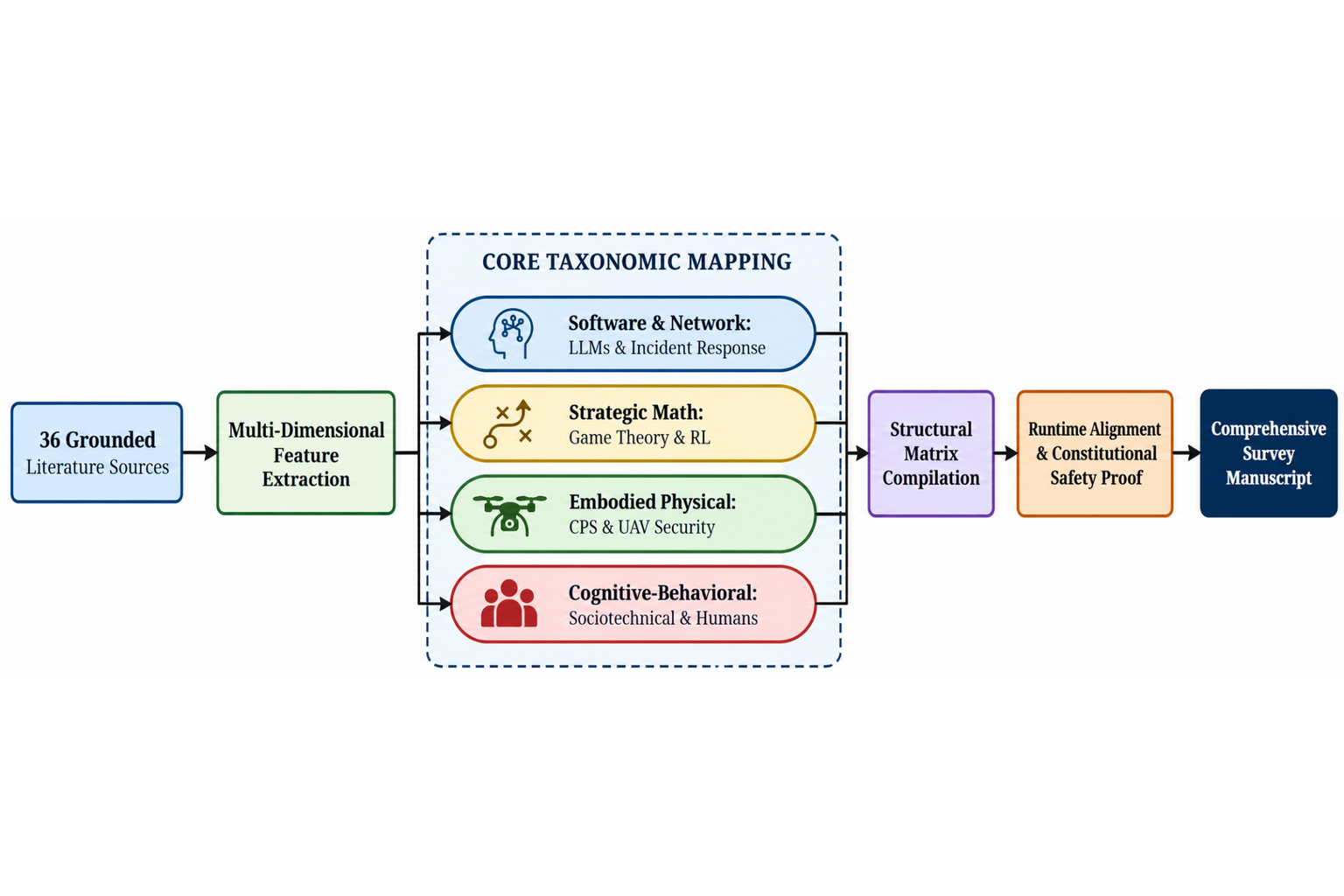
AI and Large Language Models (LLMs) are reshaping cybersecurity, moving it from signature-based reactive security to agentic, self-evolving, and proactive operations. However, the fast deployment of autonomous agents entails significant security issues, physical-layer attacks in cyber-physical systems, alignment problems, and advanced social engineering risks jeopardizing the stability of the modern sociotechnical infrastructures. This survey paper, which summarizes and analyses the literature, examines the duality of AI in cybersecurity, exploring its implications for strengthening digital defences and increasing the threat landscape for adversaries. We perform a thorough review of 36 cutting-edge research articles, which are organized into six important areas: self-evolving defensive paradigms, LLM-based intelligent agents, reinforcement learning for autonomous decision-making, security of cyber-physical systems, human-machine co-teaming, and agent alignment. Our synthesis shows that multi-agent collaborations greatly shorten incident response times and automate discovery of vulnerabilities but are also highly vulnerable to prompt injection, training data poisoning, and physical-layer spoofing. Moreover, we identify a shift from model patches to model alignment and constitutional safety at runtime as a prerequisite for securing these systems. We believe that resilient digital defence must also be considered a sociotechnical problem, as there must be agents, autonomous systems, that are governed by other agents, aligned and constitutionally bound, and are able to collaborate, rather than operate completely separately, with human operators.
Downloads
References
A. Chhabra, S. Datta, S. K. Nahin, and P. Mohapatra, “Agentic AI Security: Threats, Defenses, Evaluation, and Open Challenges,” IEEE Access, vol. 14, pp. 49455–49482, 2026, https://doi.org/10.1109/ACCESS.2026.3675554
P. Landeta-López, J. M. García, C. Guevara-Vega, and A. Ruiz-Cortés, “LLMs applied to web scraping and web crawling: a systematic review,” Computing, vol. 108, no. 6, p. 78, Jun. 2026, https://doi.org/10.1007/s00607-026-01666-5.
R. Özbay, M. Çelebı, and U. Yavanoğlu, “The AI-Cybersecurity Nexus: How Large Language Models are Reshaping Threat Intelligence and Digital Defense,” IEEE Access, vol. 14, pp. 15558–15587, 2026, https://doi.org/10.1109/ACCESS.2026.3658308.
S. Neupane et al., “Security Considerations in AI-Robotics: A Survey of Current Methods, Challenges, and Opportunities,” IEEE Access, vol. 12, pp. 22072–22097, 2024, https://doi.org/10.1109/ACCESS.2024.3363657
F. O. Olowononi, D. B. Rawat, and C. Liu, “Resilient Machine Learning for Networked Cyber Physical Systems: A Survey for Machine Learning Security to Securing Machine Learning for CPS,” IEEE Commun. Surv. Tutorials, vol. 23, no. 1, pp. 524–552, 2021, https://doi.org/10.1109/COMST.2020.3036778.
D. R. Amariles, D. Charlotin, and L. He-Guelton, “AI Agents in Payments: Applications, Risks and Regulations,” Eur. j. risk regul., pp. 1–24, May 2026, https://doi.org/10.1017/err.2026.10103
Zelenskiy, Leonid, and Andrey Sadovykh. "Automating Cybersecurity Threat Analysis with LLMs." ACM SIGAda Ada Letters 45, no. 2 (2025): 88-92, https://doi.org/10.1145/3821489.3821508
V. Vashishtha, S. Pandey, Y. R. Singh, A. Bahga, and V. K. Madisetti, “COSMIC: Leader-Driven Context-Oriented Collaboration Between Agents,” IEEE Trans. Comput. Soc. Syst., vol. 13, no. 3, pp. 3262–3287, Jun. 2026, https://doi.org/10.1109/TCSS.2026.3661839
A. Alshehri, “Developing a multi-layer agent framework to enhance AI-generated educational questions for cybersecurity,” J. Umm Al-Qura Univ. Eng.Archit., vol. 16, no. 4, pp. 1045–1056, Dec. 2025, https://doi.org/10.1007/s43995-025-00136-x
G. Lin, S. Qian, and Z. H. Khattak, “xFedCAV: Cyberattacks on Leader and Followers in Automated Vehicles With Cooperative Platoons Using Federated Agents,” IEEE Open J. Intell. Transp. Syst., vol. 6, pp. 898–914, 2025, https://doi.org/10.1109/OJITS.2025.3581617
M. Rahmati, “Federated learning for privacy-preserving AI in human–robot collaboration for smart manufacturing,” Journal of Intelligent Manufacturing and Special Equipment, vol. 6, no. 2, pp. 210–224, Sep. 2025, https://doi.org/10.1108/JIMSE-03-2025-0003
Y. Hmimou, M. Tabaa, A. Khiat, and Z. Hidila, “A Multi-Agent System for Cybersecurity Threat Detection and Correlation Using Large Language Models,” IEEE Access, vol. 13, pp. 150199–150215, 2025, https://doi.org/10.1109/ACCESS.2025.3602681
R. Addis et al., “LLM-Based Intelligent Agents for Cybersecurity: A Tutorial and Survey of Automated Vulnerability Discovery,” IEEE Access, vol. 14, pp. 100884–100917, 2026, https://doi.org/10.1109/ACCESS.2026.3707573
S. Jangirala, V. Gupta, and A. Mandal, “Large Language Models in Cybersecurity: A PRISMA-ScR-Guided Scoping Review of Threats, Defenses, and Emerging Applications,” IEEE Access, vol. 14, pp. 117961–117990, 2026, https://doi.org/10.1109/ACCESS.2026.3719163
B. A. Alli et al., “Self-evolving cyber defense: an analytical review of AI-driven autonomous and adversarial systems,” J Comput Virol Hack Tech, vol. 22, no. 1, p. 59, Jul. 2026, https://doi.org/10.1007/s11416-026-00636-x
[W. Torgbi Agbemabiese, “Toward Constitutional Autonomy in AI Systems: A Theoretical Framework for Aligned Agentic Intelligence,” IEEE Access, vol. 14, pp. 11385–11402, 2026, https://doi.org/10.1109/ACCESS.2026.3654907
S. Beg, “The human firewall: modeling AI-driven influence and human vulnerability in hybrid ecosystems,” AI & Soc, vol. 41, no. 7, pp. 7019–7043, Jul. 2026, https://doi.org/10.1007/s00146-026-02985-z
S. Islam, D. Javeed, M. S. Saeed, P. Kumar, A. Jolfaei, and A. K. M. N. Islam, “Generative AI and Cognitive Computing-Driven Intrusion Detection System in Industrial CPS,” Cogn Comput, vol. 16, no. 5, pp. 2611–2625, Sep. 2024, https://doi.org/10.1007/s12559-024-10309-w
M. Shahawy, E. Benkhelifa, and D. White, “Exploring the Intersection Between Neural Architecture Search and Continual Learning,” IEEE Trans. Neural Netw. Learning Syst., vol. 36, no. 7, pp. 11776–11792, Jul. 2025, https://doi.org/10.1109/TNNLS.2024.3453973
A. Foundjem, L. Nganyewou Tidjon, L. Da Silva, and F. Khomh, “Multi-Agent AI Framework for Threat Mitigation and Resilience in Machine Learning Systems,” ACM Trans. Softw. Eng. Methodol., p. 3780095, Jan. 2026, https://doi.org/10.1145/3780095
S. O. Albeez, P. S. Aswin Raaj, M. Nabeel, R. Kanniga Devi, and A. Kaja Mohideen, “CyberFluxAI: A GenAI-Powered System for Rapid and Explainable Cybersecurity Incident Response,” IEEE Access, vol. 14, pp. 71525–71553, 2026, https://doi.org/10.1109/ACCESS.2026.3688669
G. Mcdonald, L. Li, and R. A. Mallah, “Finding the Optimal Security Policies for Autonomous Cyber Operations With Competitive Reinforcement Learning,” IEEE Access, vol. 12, pp. 120292–120305, 2024, https://doi.org/10.1109/ACCESS.2024.3446310
S. Yoon, J.-H. Cho, D. S. Kim, T. J. Moore, F. Free-Nelson, and H. Lim, “DESOLATER: Deep Reinforcement Learning-Based Resource Allocation and Moving Target Defense Deployment Framework,” IEEE Access, vol. 9, pp. 70700–70714, 2021, https://doi.org/10.1109/ACCESS.2021.3076599
X. Cai et al., “Stability Analysis of Networked Control Systems Under DoS Attacks and Security Controller Design With Mini-Batch Machine Learning Supervision,” IEEE Trans.Inform.Forensic Secur., vol. 19, pp. 3857–3865, 2024, https://doi.org/10.1109/TIFS.2023.3347889
A. A. J. Al-Hchaimi, M. A. Al-Shareeda, A. T. Azar, and W. El-Shafai, “Reinforcement Guided Genetic Algorithm for Application Mapping in Network-on-Chip Architectures: Toward Transparent and Efficient MPSoC Scheduling,” IEEE Access, vol. 13, pp. 177520–177536, 2025, https://doi.org/10.1109/ACCESS.2025.3616179
H. E. Alami and D. B. Rawat, “RL-Enabled Lightweight Language Models for GPS Spoofing Defense in Autonomous Vehicles,” IEEE Trans.Inform.Forensic Secur., vol. 21, pp. 1424–1437, 2026, https://doi.org/10.1109/TIFS.2026.3652406
X. Zhou, H. Guo, B. Mao, Y. Xun, and N. Kato, “Cooperative Covert Communication and Task Offloading for AI-Empowered Multi-UAV Networks,” IEEE Trans. Cogn. Commun. Netw., vol. 12, pp. 9979–9991, 2026, https://doi.org/10.1109/TCCN.2026.3710515
W. Xie et al., “IRS-Assisted UAV Secure Communication via Agentic AI,” IEEE Trans. Cogn. Commun. Netw., vol. 12, pp. 10311–10326, 2026, https://doi.org/10.1109/TCCN.2026.3714068
Y. Yang et al., “VishBox: An AI-Agent-Based Adaptive Voice Phishing Simulation Framework for Cybersecurity Education,” IEEE Access, vol. 14, pp. 39672–39686, 2026, https://doi.org/10.1109/ACCESS.2026.3667823
M. Albanese et al., “Towards AI-Driven Human-Machine Co-Teaming for Adaptive and Agile Cyber Security Operation Centers,” ACM Trans. Internet Technol., p. 3819819, Jun. 2026, https://doi.org/10.1145/3819819
Hildebrandt, Michael, Shuchisnigdha Deb, Xiaoyun Yin, Jackie Cha, and Heejin Jeong. "Augmented Cognition Meets AI: Enhancing Human Performance with Real-Time, Adaptive, and Trustworthy Intelligence." In Proceedings of the Human Factors and Ergonomics Society Annual Meeting, vol. 69, no. 1, pp. 10-14. Sage CA: Los Angeles, CA: SAGE Publications, 2025, https://doi.org/10.1177/10711813251367751
D. Keshavamurthy, M. Kumar, G. Tsaramirsis, and F. Oroumchian, “An AI ‐Based Framework for Secure and Transparent Banking: Integrating Adversarial Robustness, Interpretability, and Organizational Modeling,” Security and Privacy, vol. 9, no. 1, p. e70153, Jan. 2026, https://doi.org/10.1002/spy2.70153
S. Dean, T. K. Gilbert, N. Lambert, and T. Zick, “Axes for Sociotechnical Inquiry in AI Research,” IEEE Trans. Technol. Soc., vol. 2, no. 2, pp. 62–70, Jun. 2021, https://doi.org/10.1109/TTS.2021.3074097
Z. Aminiranjbar, J. Tang, Q. Wang, S. Pant, and M. Viswanathan, “DAWN: Designing Distributed Agents in a Worldwide Network,” Oct. 28, 2024, https://doi.org/10.36227/techrxiv.173014446.64604104/v1
F. Jiang, C. Pan, K. Wang, P. Michiardi, O. A. Dobre, and M. Debbah, “From Large AI Models to Agentic AI: A Tutorial on Future Intelligent Communications,” IEEE J. Sel. Areas Commun., vol. 44, pp. 3507–3540, 2026, https://doi.org/10.1109/JSAC.2026.3660010
M. Schmitt and P. Koutroumpis, “Cyber Shadows: Neutralizing Security Threats With AI and Targeted Policy Measures,” IEEE Trans. Artif. Intell., vol. 6, no. 7, pp. 1697–1705, Jul. 2025, https://doi.org/10.1109/TAI.2025.3527398
Downloads
Published
Issue
Section
License
Copyright (c) 2026 Rupsingh Puransingh Mathwale

This work is licensed under a Creative Commons Attribution-NonCommercial 4.0 International License.