IoT-Enabled Smart Aquaculture Monitoring System for Sustainable Freshwater Fish Farming in Telangana: A Field-Informed Framework
DOI:
https://doi.org/10.68104/ijasit.v1.i4.54Keywords:
Internet of Things, freshwater aquaculture, water-quality monitoring, dissolved oxygen, pH, ESP32, LoRa, edge computing, farmer decision supportAbstract
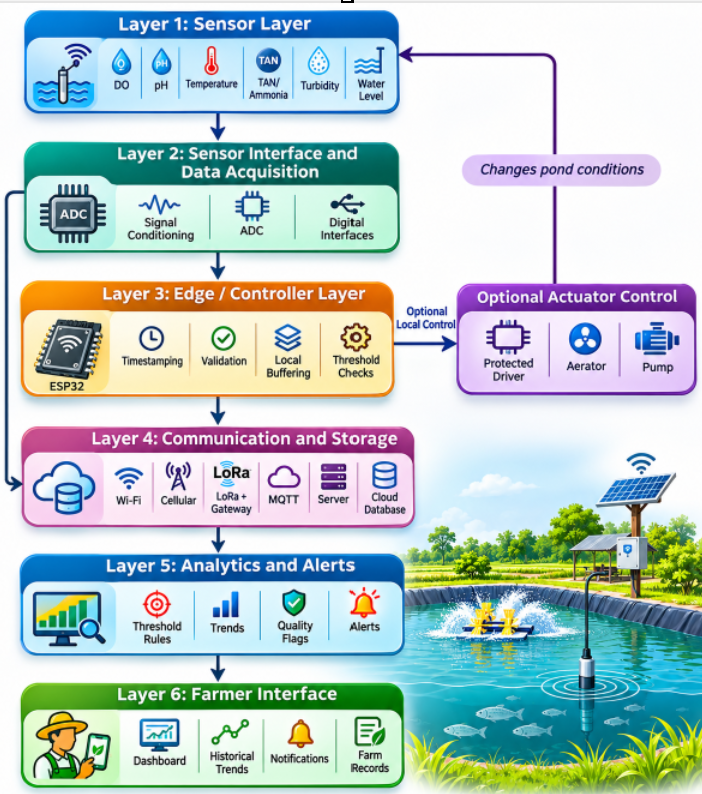
Freshwater aquaculture yield depends on water quality, stocking practices, feeding management, and timely identification of environmental stress. Conventional sporadic measurements may not capture short-term fluctuations in dissolved oxygen, pH, temperature, and ammonia that affect fish health. This paper presents a field-informed Internet of Things (IoT) framework for freshwater aquaculture monitoring in Karimnagar district, Telangana, India. The system requirements were derived from a structured farm valuation reported for 15 ponds. The proposed architecture separates the sensing layer, communication layer, cloud-storage layer sensor-interface and edge-processing layer, analytics layer, and farmer-interface layer. The framework is designed to monitor dissolved oxygen, pH, temperature, total ammonia nitrogen, turbidity, and water level, while maintaining related records of stocking, disease observations, feeding, and harvest. Wi-Fi, cellular communication, or LoRa-based transmission can be selected based on the farm connectivity and deployment requirements. The methodology incorporates data-quality checks, threshold-based alerts, historical visualization, local buffering, and a authentication methodology based on reference-instrument comparison. The planned assessment methods include mean absolute error, root mean square error, packet-delivery ratio, data completeness, Bland–Altman agreement alert latency, and system availability. The involvement of this study is a regionally informed system architecture and an integrated data model linking environmental monitoring with farm-management information. This work provides a basis for prototype implementation and empirical evaluation under freshwater aquaculture conditions.
Downloads
References
Food and Agriculture Organization of the United Nations, The State of World Fisheries and Aquaculture 2024: Blue Transformation in Action. Rome, Italy: FAO, 2024, doi: 10.4060/cd0683en.
Environmental Studies Institute, “The rise of aquaculture in India: Opportunities, challenges, and innovations,” EVS Institute, 2026. [Online]. Available: https://evs.institute/sustainable-natural-resource-management/rise-of-aquaculture-india-opportunities-challenges/
Z. Svobodová, R. Lloyd, J. Máchová, and B. Vykusová, Water Quality and Fish Health, EIFAC Technical Paper, no. 54. Rome, Italy: Food and Agriculture Organization of the United Nations, 1993.
R. Francis-Floyd, “Dissolved oxygen for fish production,” University of Florida, Institute of Food and Agricultural Sciences, Extension publication FA27. [Online]. Available: https://fisheries.tamu.edu/files/2013/09/Dissolved-Oxygen-for-Fish-Production1.pdf
C. E. Boyd and C. S. Tucker, Pond Aquaculture Water Quality Management. Boston, MA, USA: Springer, 2012.
R. P. Shete, A. M. Bongale, and D. Dharrao, “IoT-enabled effective real-time water quality monitoring method for aquaculture,” MethodsX, vol. 13, Art. no. 102906, 2024, doi: 10.1016/j.mex.2024.102906.
M. Flores-Iwasaki, G. A. Guadalupe, M. Pachas-Caycho, S. Chapa-Gonza, R. C. Mori-Zabarburú, and J. C. Guerrero-Abad, “Internet of Things (IoT) sensors for water quality monitoring in aquaculture systems: A systematic review and bibliometric analysis,” AgriEngineering, vol. 7, no. 3, Art. no. 78, 2025, doi: 10.3390/agriengineering7030078.
A. Zuhaer, A. Khandoker, N. Enayet, P. K. P. Partha, and M. A. Awal, “Sustainable aquaculture: An IoT-integrated system for real-time water quality monitoring featuring advanced DO and ammonia sensors,” Aquacultural Engineering, vol. 112, Art. no. 102620, 2026, doi: 10.1016/j.aquaeng.2025.102620.
D. Feng, Q. Han, L. Xu, F. Sohel, S. G. Hassan, and S. Liu, “An ensembled method for predicting dissolved oxygen level in aquaculture environment,” Ecological Informatics, vol. 80, Art. no. 102501, 2024, doi: 10.1016/j.ecoinf.2024.102501.
R. Baena-Navarro, Y. Carriazo-Regino, F. Torres-Hoyos, and J. Pinedo-López, “Intelligent prediction and continuous monitoring of water quality in aquaculture: Integration of machine learning and internet of things for sustainable management,” Water, vol. 17, no. 1, Art. no. 82, 2025, doi: 10.3390/w17010082.
P. Nuangpirom, S. Pitjamit, V. Jaikampan, C. Peerakam, W. Nakkiew, and P. Jewpanya, “Machine learning on low-cost edge devices for real-time water quality prediction in tilapia aquaculture,” Sensors, vol. 25, no. 19, Art. no. 6159, 2025, doi: 10.3390/s25196159.
K. Grgic, J. Spišić, and D. Žagar, “An advanced energy-efficient environmental monitoring in precision agriculture using LoRa-based wireless sensor networks,” Sensors, vol. 23, no. 14, Art. no. 6332, 2023, doi: 10.3390/s23146332.
B. M. A. Zeta, S. U. Alam, G. M. A. Ehsan Ur Rahman, and K. I. U. Ahmed, “A low-cost pH sensor for real-time monitoring of aquaculture systems in a multi-layer wireless sensor network,” Sensors, vol. 25, no. 9, Art. no. 2824, 2025, doi: 10.3390/s25092824
P. G. Arepalli and J. N. Khetavath, “A deep learning-enabled IoT framework for early hypoxia detection in aqua water using light weight spatially shared attention-LSTM network,” The Journal of Supercomputing, 2023, doi: 10.1007/s11227-023-05580-x.
N. A. Kumar and J. Vellaichamy, “Quantum LSTM-driven IoT framework for real-time monitoring of dissolved oxygen in aquaculture systems: A case study in Andhra Pradesh, India,” Water Quality Research Journal, vol. 61, no. 2, pp. 45–64, 2026, doi: 10.2166/wqrj.2026.010.
V. Biazi and C. Marques, “Industry 4.0-based smart systems in aquaculture: A comprehensive review,” Aquacultural Engineering, vol. 103, Art. no. 102360, 2023, doi: 10.1016/j.aquaeng.2023.102360.
P. G. Arepalli and K. Naik, “An IoT-based smart water quality assessment framework for aqua-ponds management using dilated spatial-temporal convolution neural network (DSTCNN),” Aquacultural Engineering, vol. 104, Art. no. 102373, 2024, doi: 10.1016/j.aquaeng.2023.102373.
M. M. Islam, M. A. Kashem, S. A. Alyami, and M. A. Moni, “Monitoring water quality metrics of ponds with IoT sensors and machine learning to predict fish species survival,” Microprocessors and Microsystems, vol. 102, Art. no. 104930, 2023, doi: 10.1016/j.micpro.2023.104930.
P. Ramesh, N. Vidhya, B. Panjavarnam, M. S. Parveen, A. M. B. Deepak, and P. T. V. Bhuvaneswari, “I-CVSSDM: IoT enabled computer vision safety system for disaster management,” EAI Endorsed Transactions on Internet of Things, vol. 10, 2024, doi: 10.4108/eetiot.5046.
P. Ramesh, N. Vidhya, P. T. V. Bhuvaneswari, and S. Parveen, “I-SOEWM: IoT based solar energized weather monitoring system,” Indian Journal of Science and Technology, vol. 16, no. 20, pp. 1505–1515, 2023, doi: 10.17485/IJST/v16i20.287.
Downloads
Published
Issue
Section
License
Copyright (c) 2026 K. Vaishali, Manjula Aakunuri

This work is licensed under a Creative Commons Attribution-NonCommercial 4.0 International License.