IoT-Enabled Real-Time Construction Project Monitoring and Predictive Management System for Schedule, Cost, and Resource Optimization
DOI:
https://doi.org/10.68104/ijasit.v1.i4.55Keywords:
Internet of Things (IoT), Construction 4.0, Predictive Analytics, Machine Learning, Building Information Modeling (BIM), Digital Twins, Earned Value Management (EVM), Project ControlsAbstract
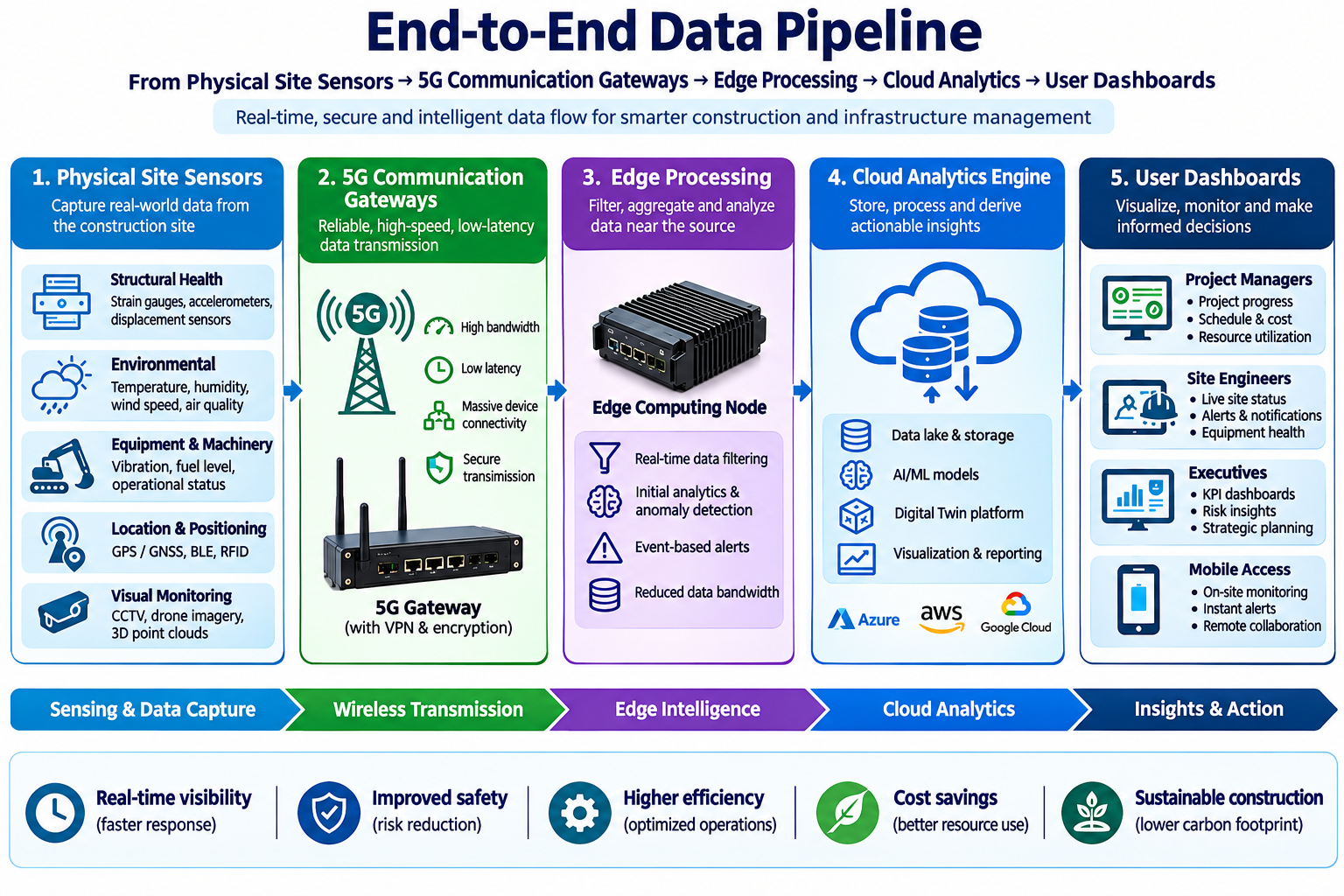
In the construction industry, severe schedule and cost overruns, retrospective performance tracking, and fragmented communication are persistent problems. The Construction 4.0 paradigm has encouraged a trend toward data-driven, real-time project management that depends on the Internet of Things (IoT), artificial intelligence (AI), and building information modelling (BIM). This systematic evaluation, which focuses on multidimensional resource optimization, schedule, and cost, critically evaluates the use of IoT technology into construction project management. By combining content primarily released between 2019 and 2026, the analysis looks at how continuous sensor data transforms traditional, reactive management frameworks—such as Earned Value Management (EVM) and the Critical Path Method (CPM)—into proactive, predictive control systems. Evidence indicates that while individual sensor technologies and machine learning delay-prediction algorithms have reached a high degree of maturity, there are currently few comprehensive platforms connecting these various data silos. This paper outlines a comprehensive nine-layer conceptual framework for fully integrated predictive construction management, identifies major implementation challenges, and explains sensor architectures, predictive models, and digital twin integrations that are revolutionizing the sector.
Downloads
References
Sweis, G., et al. (2008). Delays in construction projects: The case of Jordan. International Journal of Project Management, 26(6), 665–674. https://doi.org/10.1016/j.ijproman.2007.03.007
Sacks, R., et al. (2020). Construction 4.0: An overview of the digital transformation of the construction industry. Automation in Construction, 118, 103289. https://doi.org/10.1016/j.autcon.2020.103289
Sawhney, A., Riley, M., & Irizarry, J. (2020). Construction 4.0: An innovation platform for the built environment. Routledge. https://doi.org/10.4324/9780429325625
Tang, S., et al. (2019). A review of Internet of Things (IoT) in the construction industry: Building a smart environment. Automation in Construction, 84, 146–153. https://doi.org/10.1016/j.autcon.2018.07.005
Murguia, D., Soetanto, R., Szczygiel, M., Goodier, C. I., & Kavuri, A. (2026). Construction 4.0 implementation for performance improvement: An innovation management perspective. Construction Innovation, 26(3), 843–860. https://doi.org/10.1108/CI-01-2024-0012
Egwim, C. N., Alaka, H., Toriola-Coker, L. O., et al. (2021). Applied artificial intelligence for predicting construction project delays. Machine Learning with Applications, 6, 100166. https://doi.org/10.1016/j.mlwa.2021.100166
Page, M. J., McKenzie, J. E., Bossuyt, P. M., Boutron, I., Hoffmann, T. C., Mulrow, C. D., et al. (2021). The PRISMA 2020 statement: An updated guideline for reporting systematic reviews. BMJ, 372, n71. https://doi.org/10.1136/bmj.n71
Abdelouahid, R. A., Debauche, O., & Marzak, A. (2021). Internet of Things: A new interoperable IoT platform, application to a smart building. Procedia Computer Science, 191, 511–517. https://doi.org/10.1016/j.procs.2021.07.066
Louis, J., & Dunston, P. S. (2018). Integrating IoT into operational workflows. Automation in Construction, 94, 317–327. https://doi.org/10.1016/j.autcon.2018.07.005
Ibrahim, et al. (2021). Traditional methods of material tracking vs. IoT. Frontiers in Built Environment. https://doi.org/10.3389/fbuil.2021.650000
Osunsanmi, et al. (2018). Drone and IoT adoption in construction monitoring. Journal of Engineering, Design and Technology. https://doi.org/10.1108/JEDT-04-2018-0063
Akinosho, T. D., Oyedele, L. O., Bilal, M., Ajayi, A. O., Delgado, M. D., Akinade, O. O., & Ahmed, A. A. (2020). Deep learning in the construction industry: A review of present status and future innovations. Journal of Building Engineering, 32, 101827. https://doi.org/10.1016/j.jobe.2020.101827
Moselhi, et al. (2010). Optimizing schedules using machine learning and genetic algorithms. Journal of Construction Engineering and Management. https://doi.org/10.1061/(ASCE)CO.1943-7862.0000150
Gondia, A., et al. (2020). Machine learning models for project delay risk assessments. Engineering, Construction and Architectural Management. https://doi.org/10.1108/ECAM-03-2019-0145
Akhmedov, & Khairova. (2023). Resource scheduling in a project-driven environment using machine learning techniques. International Journal of Scientific Research in Modern Science and Technology. https://ijsrmt.com/index.php/ijsrmt/article/view/761
Castañeda, et al. (2025). Adaptive construction scheduling with AI in 4D/5D. Smart and Sustainable Built Environment. https://doi.org/10.1108/SASBE-09-2025-0552
Cheng, M. Y., Tsai, H. C., & Hsieh, W. S. (2009). Traditional cost estimation methods and artificial intelligence. Automation in Construction. https://doi.org/10.1016/j.autcon.2008.10.003
Stefano, & Filho. (2013). Activity-based costing for tighter cost control and resource allocation. Smart and Sustainable Built Environment. https://doi.org/10.1108/SASBE-2013-0012
Shirazi, & Toosi. (2023). Cost overruns and delays resulting in project failure. Journal of Construction Engineering and Management. https://doi.org/10.1061/JCEM.2023.0123
Construction Industry Development Board (CIDB). (2022). Construction 4.0 strategic plan. Construction Industry Development Board Malaysia. https://ijeber.com/uploads2025/ijeber_05_391.pdf
Celik, Y., Petri, I., & Rezgui, Y. (2023). Digital Circularity Alignment Model (DCAM) for construction. Journal of Building Engineering. https://doi.org/10.1080/19397038.2026.2619254
Bahroun, et al. (2023). AI-based strategies for schedule optimization, delay prediction, and task sequencing. International Journal of Scientific Research in Modern Science and Technology. https://ijsrmt.com/index.php/ijsrmt/article/view/761
Sarkar, et al. (2018). Machine learning techniques for identifying hidden patterns in project information. International Journal of Research and Innovation in Social Science. https://rsisinternational.org/journals/ijriss/article/ml-patterns/
Hassija, et al. (2024). Difficulties in interpreting AI models: The black-box problem. Automation in Construction. https://aspa.sggw.edu.pl/article/view/10876
Brilakis, I., et al. (2019). Digital twins in the built environment. Automation in Construction. https://doi.org/10.1016/j.autcon.2019.102969
Hatoum, & Nassereddine. (2020). Barriers to adopting automation technologies on construction sites. Frontiers in Built Environment. https://doi.org/10.3389/fbuil.2020.00075
Pan, & Zhang. (2021). Artificial intelligence and machine learning in construction project management. International Journal of Research and Innovation in Social Science. https://rsisinternational.org/journals/ijriss/article/ai-in-construction/
Hu, et al. (2022). Digital twin generation and applications in the built environment. Automation in Construction. https://doi.org/10.1016/j.autcon.2022.104251
Downloads
Published
Issue
Section
License
Copyright (c) 2026 Anmol Singh Chani

This work is licensed under a Creative Commons Attribution-NonCommercial 4.0 International License.