Machine Learning-Based Non-Revenue Water Management in Smart Cities: A Systematic Review of Leakage Detection, Prediction and Decision Support
DOI:
https://doi.org/10.68104/ijasit.v1.i4.58Keywords:
Water distribution networks, machine learning; smart water, IoT, pressure sensors, acoustic sensing, leak detection, leak localization, non-revenue water, predictive maintenancAbstract
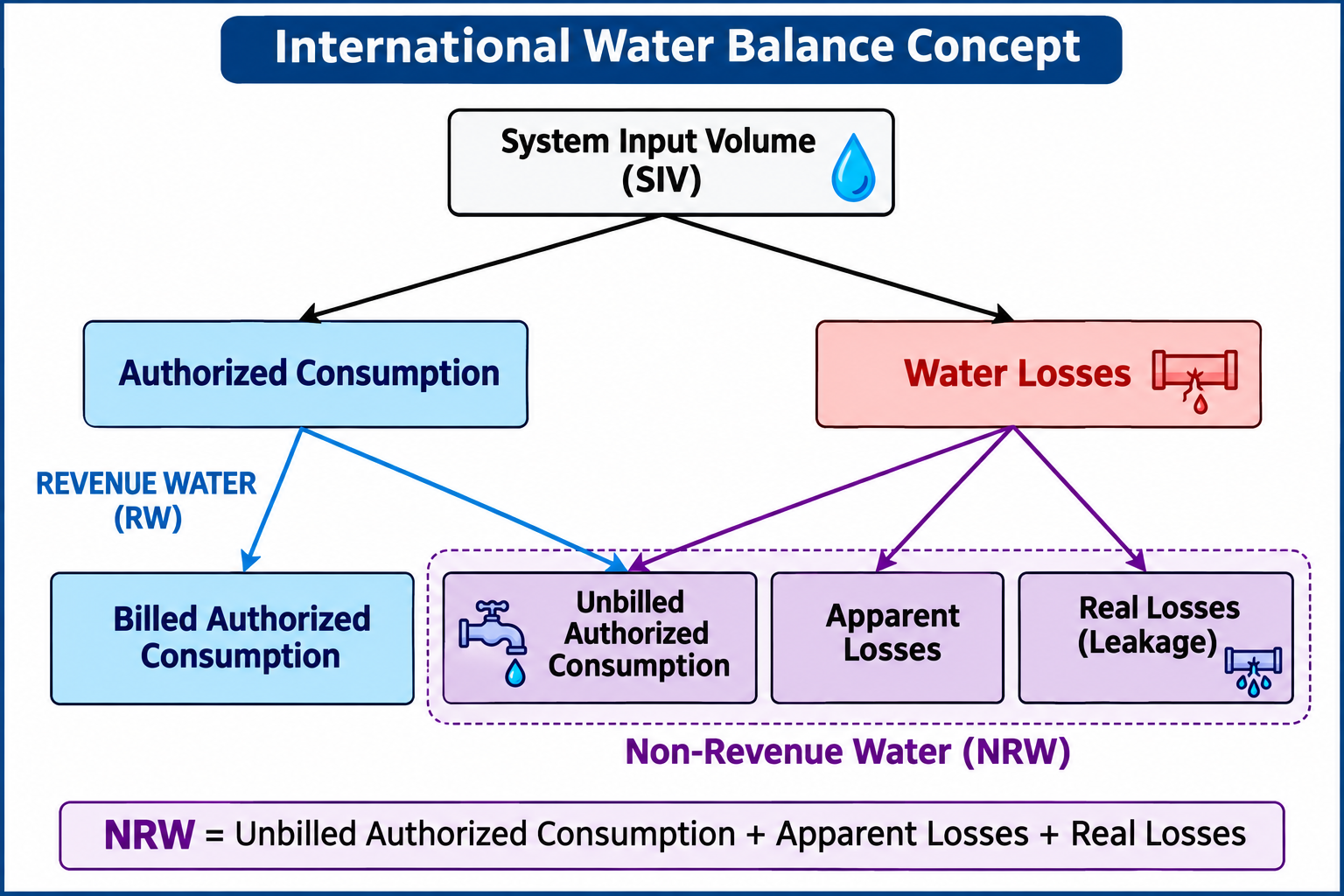
Water entering a distribution system may be lost physically through leaks, lost economically through metering and billing issues, or used without being invoiced, making Non-Revenue Water (NRW) a recurring concern for metropolitan water utilities. In order to identify anomalous network behavior, locate leaks, and assist with operational decisions, machine learning (ML), the Internet of Things (IoT), advanced metering infrastructure (AMI), hydraulic modeling, and cloud/edge computing are rapidly being integrated. With a focus on leakage detection, localization, prediction, and decision support, this paper summarizes the development of data-driven NRW management. Data sources, pre-processing and feature engineering, algorithm families, validation procedures, and operational deployment are the five dimensions around which the evidence is arranged in the review, which follows an organized systematic-review approach based on PRISMA 2020. In addition to hydraulic-model residuals and network architecture, pressure, flow, acoustic, and AMI data are analyzed. While CNN, LSTM, and graph-based models are increasingly employed for spatial, temporal, and topological patterns, traditional machine learning models like support vector machines, random forests, and gradient-boosting techniques are still helpful when datasets are moderate and manufactured features are instructive. Moving from high-performing laboratory or simulated trials to resilient utility-scale deployment with sensor sparsity, noise, demand unpredictability, network changes, and limited labeled leak occurrences is another important research problem, according to recent studies. Thus, a closed-loop NRW management system that connects sensing, data quality control, machine learning inference, hydraulic validation, field verification, repair priority, and model retraining is proposed in the review. Standardized datasets, leakage-specific assessment methods, cross-network validation, explainable and physics-informed machine learning, cybersecurity, model-drift management, and economic decision support are important research needs. The study comes to the conclusion that machine learning (ML) should not be used as a stand-alone substitute for hydraulic engineering and field practice, but rather as a decision-support layer inside a larger water-loss-control program.
Downloads
References
Lambert, A. O., Brown, T. G., Takizawa, M., & Weimer, D. (1999). A review of performance indicators for real losses from water supply systems. Aqua—Journal of Water Supply Research and Technology, 48(6), 227–237. https://doi.org/10.2166/aqua.1999.0025
Farley, M., & Liemberger, R. (2005). Developing a non-revenue water reduction strategy: Planning and implementing the strategy. Water Supply, 5(1), 41–50. https://doi.org/10.2166/ws.2005.0006
Puust, R., Kapelan, Z., Savic, D. A., & Koppel, T. (2010). A review of methods for leakage management in pipe networks. Urban Water Journal, 7(1), 25–45. https://doi.org/10.1080/15730621003610878
Mounce, S. R., & Machell, J. (2006/2007). Burst detection using hydraulic data from water distribution systems with artificial neural networks. Urban Water Journal, 3(1), 21–31. https://doi.org/10.1080/15730620600578538
Romano, M., Kapelan, Z., & Savic, D. A. (2014). Automated detection of pipe bursts and other events in water distribution systems. Journal of Water Resources Planning and Management, 140(4), 457–467. https://doi.org/10.1061/(ASCE)WR.1943-5452.0000339
Farah, E., & Shahrour, I. (2017). Leakage detection using smart water system: Combination of water balance and automated minimum night flow. Water Resources Management, 31, 4821–4833. https://doi.org/10.1007/s11269-017-1780-9
Liu, Y., Ma, X., Li, Y., Tie, Y., Zhang, Y., & Gao, J. (2019). Water pipeline leakage detection based on machine learning and wireless sensor networks. Sensors, 19(23), 5086. https://doi.org/10.3390/s19235086
Singh, M., & Ahmed, S. (2021). IoT based smart water management systems: A systematic review. Materials Today: Proceedings, 46, 5211–5218. https://doi.org/10.1016/j.matpr.2020.08.588
Mashhadi, N., Shahrour, I., Attoue, N., El Khattabi, J., & Aljer, A. (2021). Use of machine learning for leak detection and localization in water distribution systems. Smart Cities, 4(4), 1293–1315. https://doi.org/10.3390/smartcities4040069
Ravichandran, T., Gavahi, K., Ponnambalam, K., & Mousavi, S. J. (2021). Ensemble-based machine learning approach for improved leak detection in water mains. Journal of Hydroinformatics, 23(2), 307–323. https://doi.org/10.2166/hydro.2021.093
Abdelmageed, S., Tariq, S., Boadu, V., & Zayed, T. (2022). Criteria-based critical review of artificial intelligence applications in water-leak management. Environmental Reviews, 30(2), 280–297. https://doi.org/10.1139/er-2021-0046
Vanijjirattikhan, R., Khomsay, S., Kitbutrawat, N., Khomsay, K., et al. (2022). AI-based acoustic leak detection in water distribution systems. Results in Engineering, 15, 100557. https://doi.org/10.1016/j.rineng.2022.100557
Fu, G., Jin, Y., Sun, S., Yuan, Z., & Butler, D. (2022). The role of deep learning in urban water management: A critical review. Water Research, 223, 118973. https://doi.org/10.1016/j.watres.2022.118973
Shen, Y., & Cheng, W. (2022). A tree-based machine learning method for pipeline leakage detection. Water, 14(18), 2833. https://doi.org/10.3390/w14182833
Rousso, B. Z., Lambert, M., & Gong, J. (2023). Smart water networks: A systematic review of applications using high-frequency pressure and acoustic sensors in real water distribution systems. Journal of Cleaner Production, 410, 137193. https://doi.org/10.1016/j.jclepro.2023.137193
Mahdi, N., Hikmet, A., Abulqasim, S., Basem, A., et al. (2024). Leak detection and localization in water distribution systems using advanced feature analysis and an artificial neural network. Desalination and Water Treatment, 320, 100685. https://doi.org/10.1016/j.dwt.2024.100685
Gómez-Coronel, L., Santos-Ruiz, I., Blesa, J., Puig, V., & Lopez-Estrada, F. R. (2024). Leak localization in an urban water distribution network using a LSTM deep neural network. IFAC-PapersOnLine, 58(4), 79–84. https://doi.org/10.1016/j.ifacol.2024.07.197
Jun, S., Jung, D., & Lansey, K. (2024). Three-dimensional convolutional neural network for leak detection and localization in smart water distribution systems. Water Research X, 25, 100264. https://doi.org/10.1016/j.wroa.2024.100264
Farah, E., & Shahrour, I. (2026). Standardization and benchmarking of datasets and evaluation protocols for machine learning-based water leak detection: A systematic review. Water, 18(18), 2267. https://doi.org/10.3390/w18182267
Ranganathan, S., Vinothkumar, N., & Muthuramalingam, E. (2026). Benchmarking diverse learning architectures for leak detection and localization in water distribution systems. Journal of Water Process Engineering, 87, 110114. https://doi.org/10.1016/j.jwpe.2026.110114
Downloads
Published
Issue
Section
License
Copyright (c) 2026 Varsha Katia, Namira Saiyad

This work is licensed under a Creative Commons Attribution-NonCommercial 4.0 International License.